Article
What Is Conversational Search? Meaning, Examples, and Why It Matters
More people now begin their questions somewhere other than a traditional search box.
They ask an AI system to explain a concept. They ask an answer engine to compare options. They ask a browser assistant, a productivity app, or a system-level interface to summarize what used to require several searches, several tabs, and several small acts of judgment.
The change is easy to underestimate because it still looks familiar. A person types a question. A machine returns information. The screen gives the impression of access.
But underneath that familiar gesture, the relationship is changing.
The important question is not whether AI search is useful. It is. The more interesting question is what kind of web it encourages us to build: a web of destinations, or a web of extracted answers.
What Is Conversational Search?
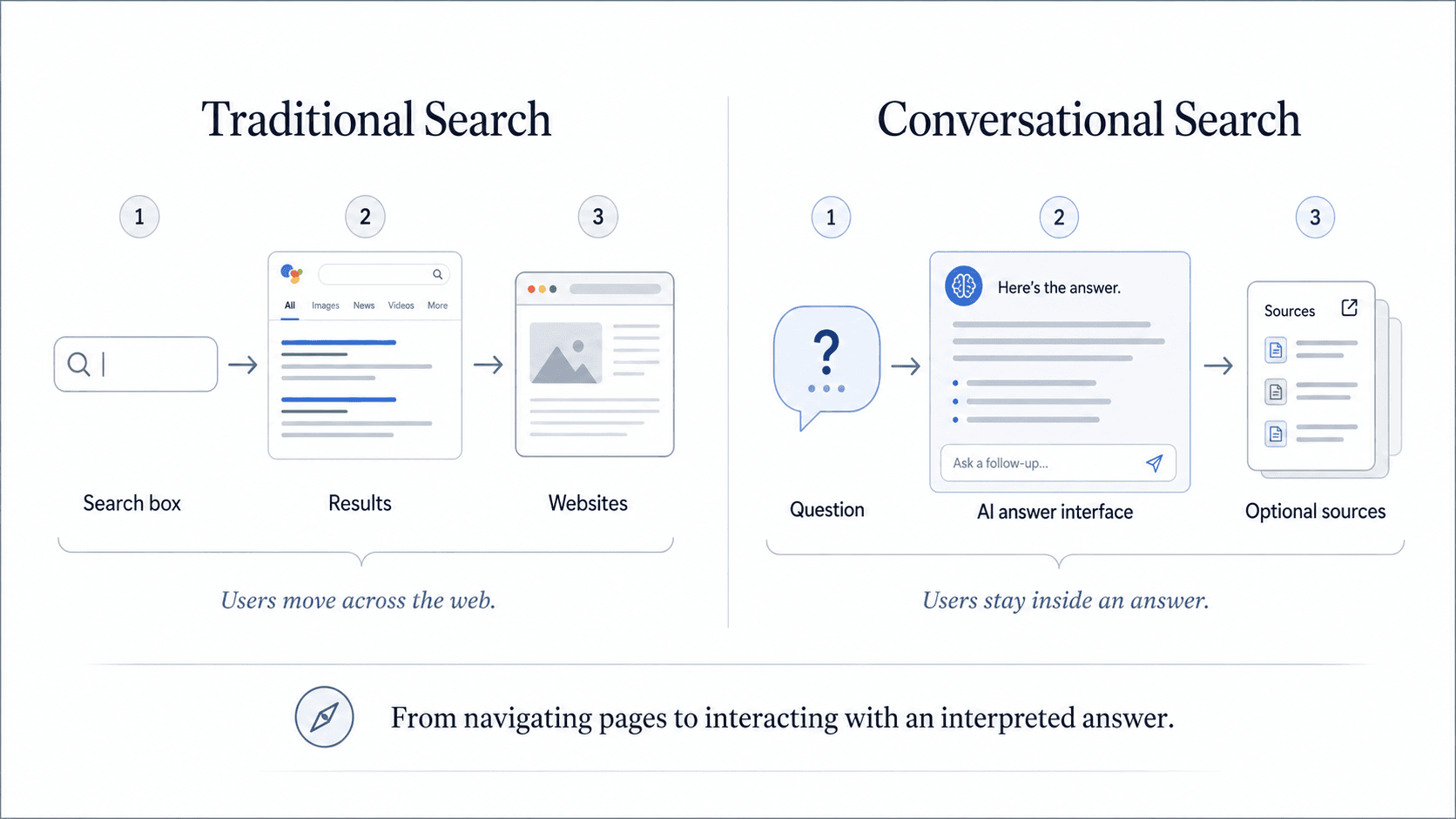
Conversational search is a way of finding information by asking natural-language questions and receiving interpreted answers, rather than only scanning a list of links. It is closely related to AI search, answer engines, and chat-based search interfaces.
In traditional search, users type keywords, compare results, and visit websites. In conversational search, users can ask follow-up questions, refine intent, and stay inside an answer interface for longer.
Traditional search asked users to move across the web. Conversational search asks users to stay inside an answer.
That difference may become one of the defining shifts in digital discovery: not because links disappear overnight, and not because websites suddenly stop mattering, but because the path between curiosity and information is being rebuilt.
Search Used to Be a Map
For most of the modern web, search worked like a map.
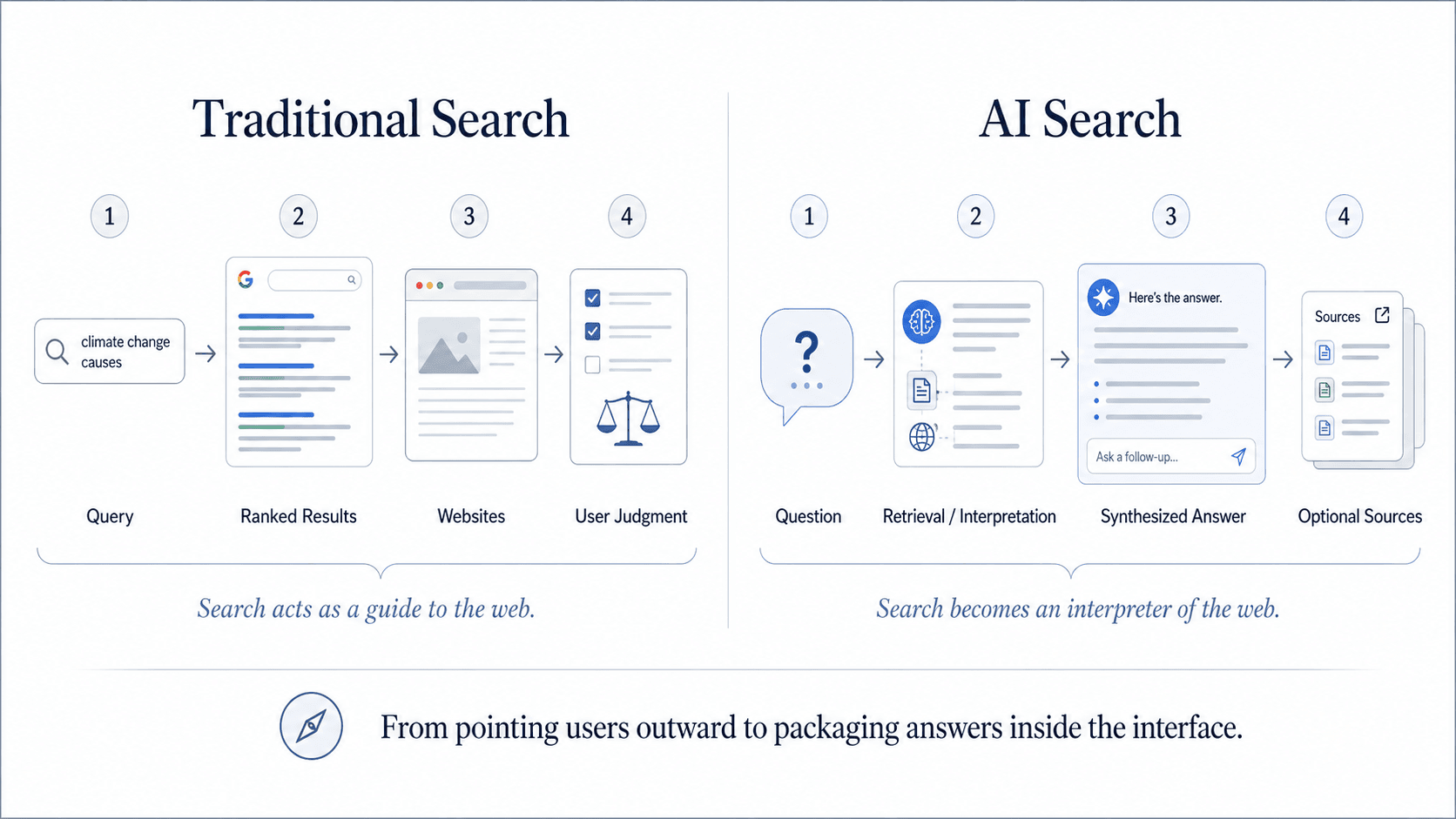
It did not usually claim to be the destination. It indexed pages, ranked them, and pointed people outward. A user typed a query, scanned a list of results, opened several pages, compared snippets, judged credibility, and slowly assembled an answer from multiple sources.
This model had many problems. Search rankings could be gamed. Pages were often overloaded with ads. SEO incentives encouraged repetition, keyword targeting, and shallow content. Many informational pages existed less because they had something original to say and more because they could capture traffic from a known query.
Still, the structure had one important feature: search created movement.
It sent people to websites. It made discovery visible. It gave independent blogs, niche publishers, small businesses, technical forums, product pages, and personal projects at least some chance of being found by strangers.
The search engine was powerful, but it was also a bridge. It sat between the user and the web, not entirely in place of the web.
That bridge shaped the economics of online publishing. A recipe site, a software tutorial, a product review blog, a local business, or a long-running independent publication could build an audience because search could route intent toward it. The user’s question became a visit. The visit could become trust, subscription, purchase, community, or habit.
This was never a perfectly fair system. But it was a system in which websites were still the primary containers of information.
Conversational Search Becomes an Interpreter
AI search changes the function of the interface.
Instead of returning a list of possible destinations, it often returns a synthesized answer. It reads across material, compresses context, removes repetition, and presents something closer to a finished explanation. The user may still see links or citations, but the first experience is no longer a map. It is an interpretation.
That is a deeper change than it first appears.
A list of links asks the user to choose. A conversational answer asks the user to accept, refine, or continue the conversation. In the first model, attention moves outward. In the second, attention stays inside the interface.
This does not mean conversational search is simply worse. In many situations, it is useful. It can clarify unfamiliar terms, compare concepts, summarize documentation, explain trade-offs, and help users ask better follow-up questions. For people who do not know the right keywords, AI search can reduce friction. For complex questions, it can provide a starting structure.
The issue is not convenience. The convenience is real.
The issue is what happens when the interface becomes an interpreter of the web rather than a guide to the web.
When answers are summarized before the user reaches the source, the source becomes less visible. Its voice, context, uncertainty, and surrounding argument may be flattened. A careful essay, a product page, a forum discussion, and a documentation page can all become fragments inside a response.
The web becomes raw material.
What This Means for Websites
The first effect will likely be uneven.
Simple informational queries are the most exposed. Definitions, basic comparisons, quick instructions, factual summaries, and common troubleshooting steps are exactly the kinds of things conversational systems are designed to answer without requiring many clicks.
For independent websites, blogs, publishers, and small businesses, this creates a difficult reality: some pages that once attracted visitors may become less effective as entry points. A user who previously clicked a tutorial, glossary, buying guide, or explainer may now receive enough information directly in the AI interface.
This is not only an SEO problem. It is a discovery problem.
If fewer users arrive at the original page, fewer users encounter the publication’s voice. Fewer people notice the author behind the explanation. Fewer readers move from one article to another. Fewer visitors become subscribers, customers, followers, or members of a community.
For small websites, the lesson is not to abandon search. It is to stop building pages that only survive when search engines send accidental visitors. The more durable path is to build pages that deserve direct return: essays people remember, references people bookmark, tools people use, and perspectives they associate with a name. Search traffic still matters, but trust, return visits, and durable value matter more when the interface between the user and the web becomes less predictable.
In a conversational search environment, websites may need to become valuable in ways that cannot be fully compressed into a short answer. That includes:
| Website Value | Why It Matters More in Conversational Search |
|---|---|
| Original perspective | AI can summarize common knowledge more easily than it can replace a distinct point of view. |
| Firsthand experience | Lived practice, field notes, case studies, and experiments carry context that generic summaries lack. |
| Tools and utilities | Calculators, templates, interactive demos, databases, and workflows give users a reason to visit directly. |
| Community | Discussion, identity, and belonging are difficult to reduce to a single answer. |
| Brand trust | Users may seek out sources they recognize when the information affects decisions. |
| Durable archives | Deep, well-organized bodies of work can become reference points beyond individual queries. |
The website does not disappear. But the weak website becomes easier to bypass.
A site that only repackages common information may struggle. A site that offers judgment, taste, evidence, utility, or a recognizable intellectual position may become more important, not less.
What This Means for Writers and Publishers
For writers, the old bargain was already under pressure.
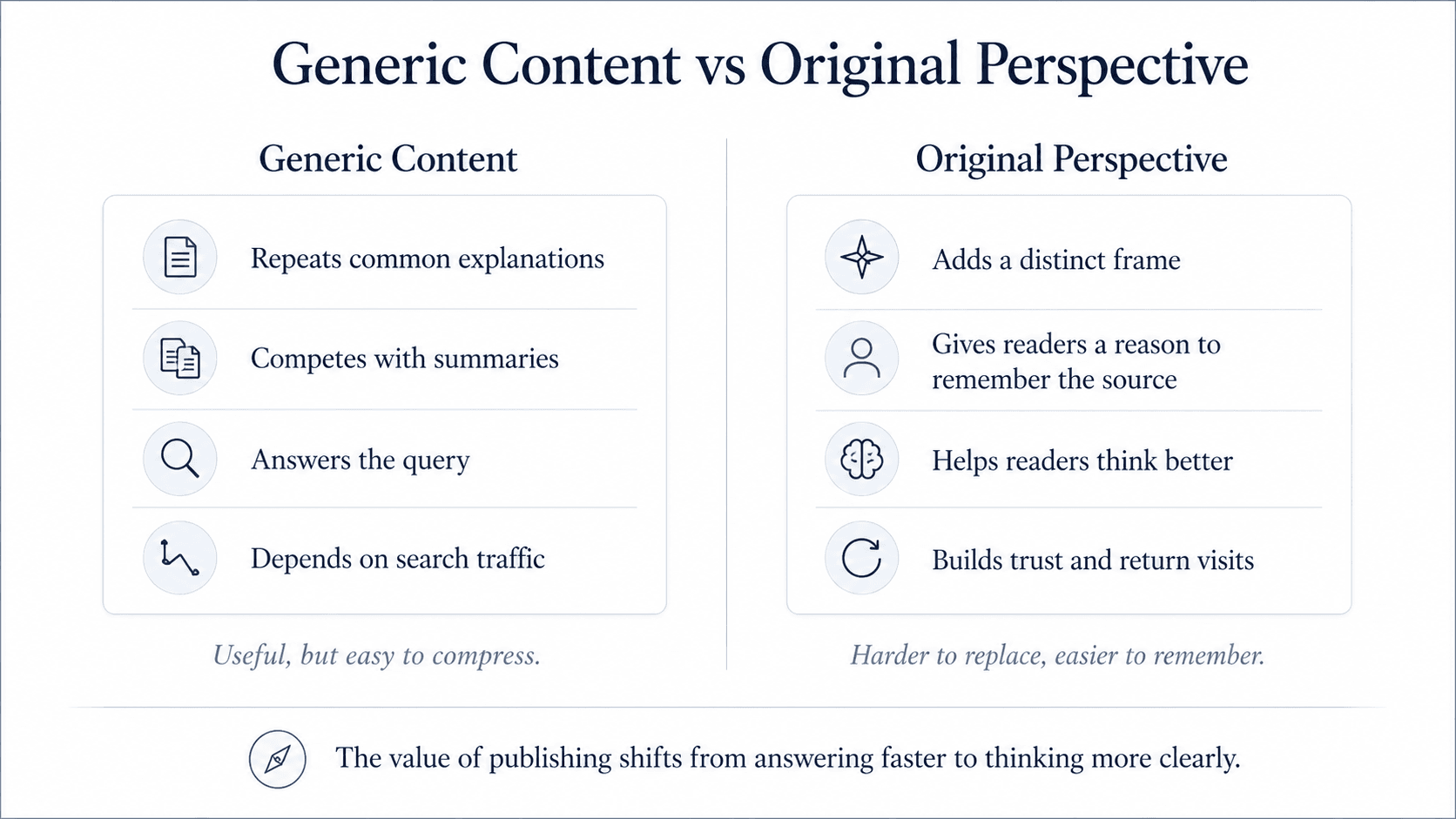
Generic information became cheap long before AI search. Search engines rewarded coverage. Content systems rewarded volume. Many websites learned to produce articles that answered predictable questions with predictable structures. The result was a web filled with pages that were technically useful but rarely memorable.
Conversational search accelerates the decline of that model.
If an AI system can answer “what is,” “how to,” or “best way to” questions by blending existing explanations, then the value of merely restating known information falls. A writer who only produces clean summaries of common knowledge is competing with a machine optimized for clean summaries of common knowledge.
That does not make writing less valuable. It makes certain kinds of writing less defensible.
The Work That Becomes More Valuable
Writers and publishers will need to lean into the parts of writing that are hardest to synthesize without loss:
- Original observation
- Firsthand reporting
- Clear judgment
- Strong framing
- Taste and editorial selection
- Deep context
- Honest uncertainty
- Narrative memory
- A recognizable voice
The question is no longer only, “Can this page answer the query?”
The stronger question is, “Why should this answer come from us?”
A publication that has no answer to that question may find itself absorbed into the general answer layer of the internet. A publication that does have an answer may become a source people deliberately seek out.
A Practical Editorial Checklist
Before publishing, writers may need to ask:
- Does this piece say anything that is not already obvious?
- Does it contain firsthand experience, original analysis, or a distinct frame?
- Would a reader remember where they read it?
- Does the article help someone think better, not just know faster?
- Is the value still present after the basic facts are summarized?
- Does this piece strengthen the identity of the publication?
This checklist is not a rejection of SEO. Search visibility still matters. But SEO without editorial identity becomes weaker when search becomes conversational.
What This Means for Products
Product discovery may change in a similar way.
For years, many users discovered products through manual search. They searched for “best note-taking app,” “project management tool for small teams,” “affordable standing desk,” or “CRM for freelancers.” They clicked comparison pages, review sites, product landing pages, forum discussions, video reviews, and marketplace listings.
Conversational AI introduces a different behavior. A user may ask:
“What is the best writing app for someone who manages long research notes?”
“Which analytics tool is good for a small content website?”
“What are alternatives to Notion for a privacy-conscious team?”
“What should I buy if I want something reliable, simple, and not too expensive?”
These are not just keyword searches. They are preference-shaped requests.
If AI systems become more involved in product recommendation, product visibility may depend less on ranking for one phrase and more on the broader public structure around the product: how it is described, reviewed, compared, documented, and understood.
That means several things may matter more:
- Clear positioning
- Consistent public information
- Strong documentation
- Trustworthy reviews
- Recognizable brand signals
- Transparent pricing
- Useful comparison pages
- Structured product data
- Active user communities
- Reputation across multiple sources
A product that is hard to understand may be hard to recommend. A product with vague positioning may be summarized poorly. A product with scattered or inconsistent information may lose visibility inside systems that depend on interpretation.
This creates a new kind of product communication problem.
The product page still matters, but it is no longer speaking only to human visitors. It is also part of a wider information environment that may be interpreted by AI systems, review platforms, communities, and aggregators.
The basic question changes from “How do we rank?” to “How clearly does the internet understand what this product is for?”
The Difference Between Answers and Understanding
There is another layer beneath the practical changes.
Conversational search is very good at making information feel resolved. It gives shape to messy topics. It reduces friction. It removes the need to open ten tabs. It turns uncertainty into a response.
That can be useful. It can also be misleading.
Getting an answer is not the same as understanding a topic.
An answer can be correct and still shallow. It can be clear and still incomplete. It can be efficient and still remove the path by which a person would have encountered disagreement, context, source quality, or the texture of a subject.
Understanding often requires friction. It requires moving between sources, noticing contradictions, reading slowly, comparing arguments, and seeing how a claim is situated. It requires the parts of research that are inconvenient but intellectually important.
A conversational interface can support that process if used carefully. It can also short-circuit it.
This matters for digital culture because the internet is not only an answer machine. It is also a memory system, a publishing environment, a marketplace, a social archive, and a place where small voices can become discoverable.
If search behavior shifts toward asking and receiving rather than exploring and judging, the culture of the web changes with it.
The Open Web After the Answer
The open web will not simply vanish if search becomes conversational.
People will still visit websites. They will still read publications they trust, use tools, buy products, join communities, follow creators, and search for deeper context. Businesses will still need pages. Writers will still need homes for their work. Products will still need clear explanations. Archives will still matter.
But the role of the website may change.
A website can no longer assume that publishing information is enough. It may need to become a stronger signal of trust, perspective, and durable value. It may need to give people reasons to arrive directly, return intentionally, and remember the source.
For independent websites, this is both a threat and an invitation.
The threat is obvious: the middle layer of digital discovery may absorb more attention. The casual visitor may become harder to reach. The basic informational page may lose some of its old function.
The invitation is quieter: to build things that are not merely answerable.
A thoughtful website can become a place of interpretation rather than just information. A journal can become a record of how someone sees the world. A product site can become a clear expression of who it serves and why it exists. A publisher can become known not only for covering topics, but for making sense of them.
This is where slower publishing still has a role. Not everything important about technology appears first as a headline, a product update, or a market signal. Some changes reveal themselves through habits: how people search, what they stop clicking, which sources they remember, which interfaces they trust, and what kind of knowledge they are willing to outsource.
In a web increasingly shaped by conversational answers, there is room for spaces that do not rush to resolve everything. Spaces that observe, connect, question, and return to ideas over time. Spaces that treat technology not only as a tool, but as an environment that changes behavior, economics, memory, and culture.
Conversational search may make answers easier to obtain.
It may also make genuine understanding more valuable.