Article
Why Independent Websites Still Matter When Answers Are Everywhere
People increasingly get answers without visiting many original websites.
They ask AI tools to summarize a topic. They scan platform feeds shaped by recommendation systems. They read search summaries before clicking anything. They receive fragments of explanation, comparison, opinion, and advice inside interfaces that are designed to reduce the need for further navigation.
At first glance, this can make independent websites feel less necessary.
If an answer is already available inside a search result, a chatbot, a social feed, or a product interface, why should someone visit a separate website at all? Why maintain a domain, an archive, a design system, and a publishing structure when so much digital discovery now happens elsewhere?
The answer is not nostalgia. It is not that the older web was pure, or that platforms are inherently empty, or that every independent website is automatically valuable.
The stronger answer is quieter: independent websites still matter because their role is changing.
They are becoming less valuable as simple containers of information and more valuable as durable places of trust, memory, ownership, context, and perspective. In an internet increasingly shaped by extracted answers, a good website gives ideas somewhere to accumulate. It gives a project a stable home. It gives a reader a place to return to, not just a page to land on.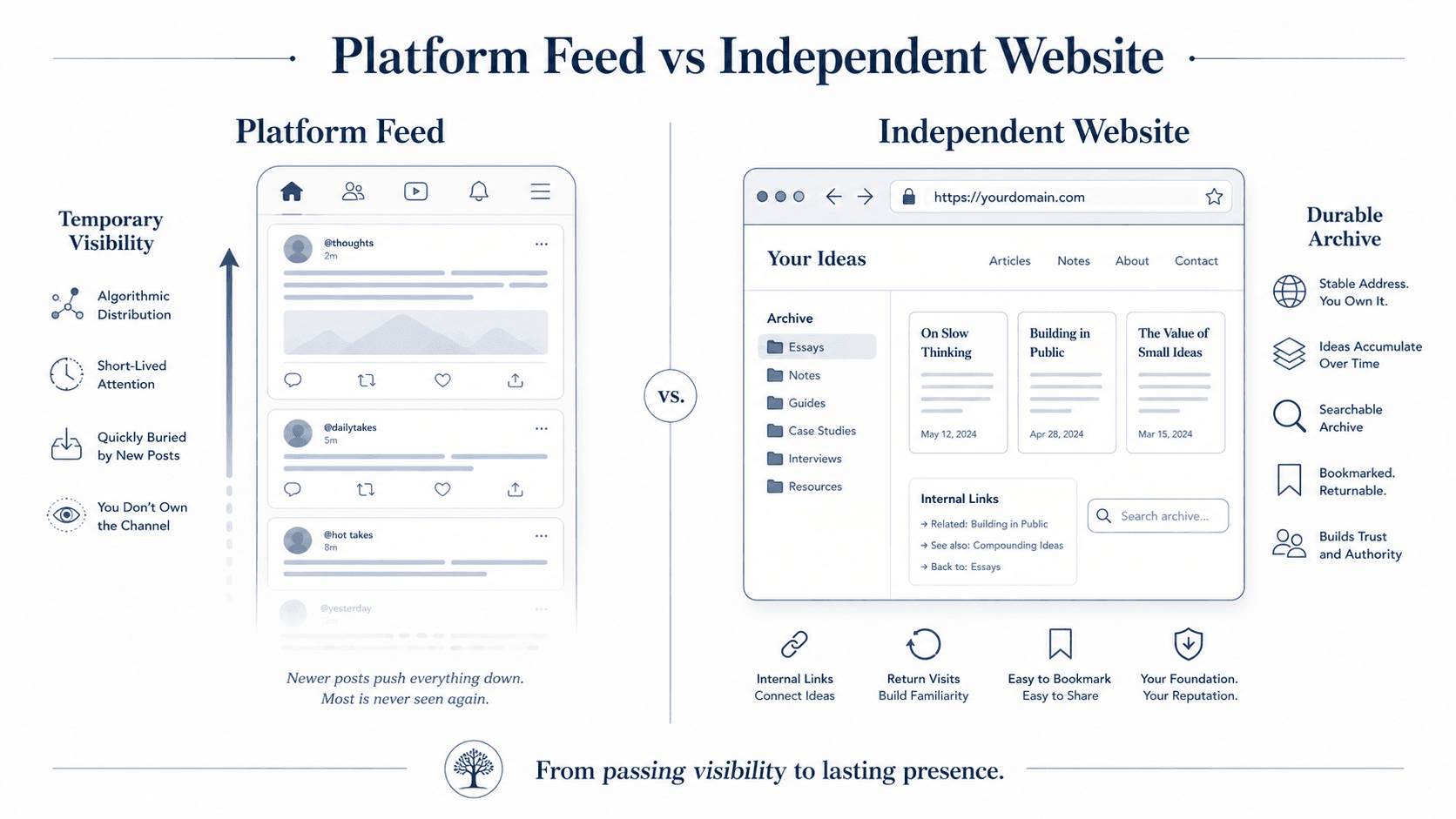
The Old Role of Independent Websites
Independent websites were never only pages.
They were homes.
A personal site could hold essays, notes, experiments, photographs, reading lists, and unfinished ideas. A small business website could explain what the business did, where it came from, what it believed, and how to reach it. A software project could use a website as documentation, roadmap, archive, changelog, support center, and public memory. A publication could build a recognizable editorial identity through the slow accumulation of articles.
The independent website worked as a destination. It had an address. It had structure. It had some degree of continuity. A visitor could arrive through search, a link, a recommendation, or habit, and then move through a body of work that belonged together.
This mattered because the web was not only a stream. It was also a place.
A blogroll, a documentation site, a forum, a portfolio, a niche magazine, a local shop, a research archive, a tool directory, or a product page could all exist as distinct parts of the web. They could be linked to, cited, bookmarked, revisited, and remembered.
That old model was imperfect. Many sites were difficult to navigate. Many were abandoned. Search incentives pushed publishers toward shallow coverage. Advertising made parts of the web unpleasant to use. The open web was never as clean as memory sometimes makes it seem.
But the independent website gave creators, businesses, and projects something important: a place that was not entirely defined by a feed.
The New Pressure from Answer Interfaces
The pressure today comes from a different pattern of discovery.
For many simple informational queries, users may not need to click through as often as they once did. AI search, search summaries, social feeds, recommendation systems, and in-product assistants can surface enough information to satisfy immediate intent.
This does not mean websites stop mattering. It does not mean search traffic disappears. It does not mean every user will prefer a generated summary over a primary source.
But in some cases, the path is becoming shorter.
A person wants a quick explanation, a definition, a comparison, a basic troubleshooting step, or a simple recommendation. Instead of visiting several pages, they receive a packaged response. The original sources may appear as citations, links, cards, or background material. But the first experience is no longer necessarily a visit. It is an answer.
As explored in What Happens When Search Becomes Conversational?, search is shifting from a map of links toward an interface of interpreted answers.
That shift changes the question for independent websites.
The old question was often: “How do we get found?”
The newer question is more demanding: “Why should someone remember us after the answer is given?”
Why Ownership Still Matters
Ownership sounds abstract until the ground moves.
A platform changes its algorithm. A feed stops showing posts to the same audience. An account is limited, copied, suspended, buried, or made less useful by a product change. A format that once worked becomes invisible. A profile that once felt central becomes one surface among many.
This is not an argument against platforms. Platforms can be useful. They create distribution, discovery, community, and conversation. For many creators and businesses, they are necessary parts of the public internet.
But a platform presence is not the same as a durable home.
An independent website gives a project its own address. It gives the owner control over structure, navigation, presentation, archives, and context. It allows a body of work to be organized according to its own logic rather than the logic of a timeline, feed, or recommendation system.
A domain is not magic. A website does not guarantee attention. But it creates a stable center.
That center matters more when discovery becomes fragmented. A reader may first encounter a project through a search summary, a social post, a newsletter mention, a citation, a video, or an AI-generated answer. The independent website is where those fragments can resolve into something coherent.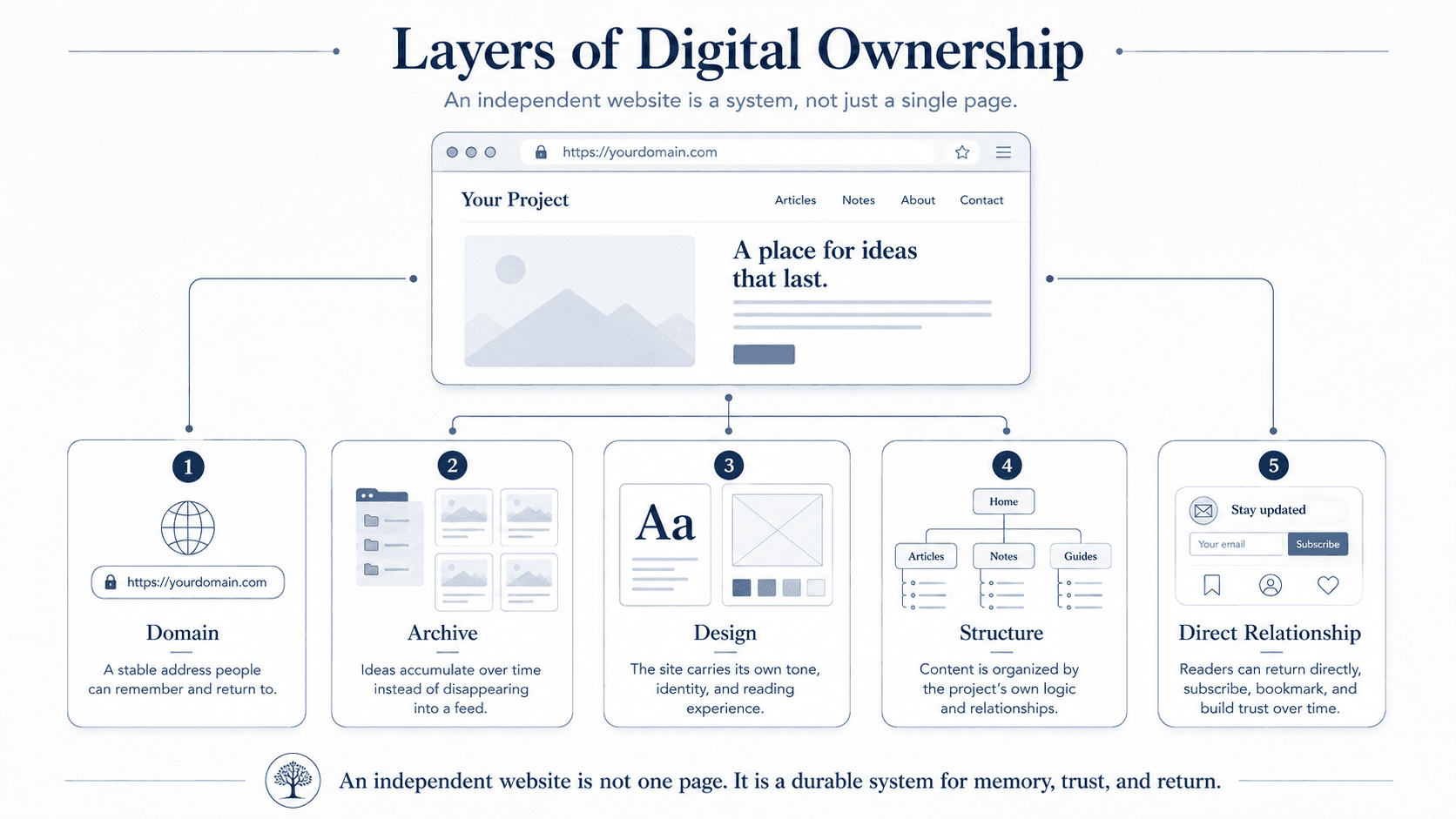
The Layers of Digital Ownership
A useful independent website often combines several forms of ownership:
- A domain that can be remembered and shared
- An archive that does not disappear into a feed
- A structure that reflects the project’s own priorities
- A design that carries tone and identity
- A publishing system that can evolve over time
- A direct relationship with readers, customers, or users
None of these layers removes dependence on the wider internet. A website still relies on hosting, search, browsers, standards, links, and external discovery. But it gives a project more continuity than a platform profile alone.
Why Trust Matters More Than Traffic
Traffic is measurable. Trust is harder to count.
That is one reason online publishing has often overvalued traffic. Pageviews, impressions, rankings, clicks, and referrals are easier to report than credibility, memory, or influence. They create dashboards. They create urgency. They create the feeling that progress is visible.
But traffic alone is not enough, especially in an answer-driven web.
A person may encounter a summary first. They may see a compressed explanation before they see the original source. They may ask an AI system for a comparison and receive a short list of names. In that environment, the question becomes less about whether a website can attract a single visit and more about whether it can become a trusted reference.
Trust changes user behavior.
People return to sources they trust when the question is complex, consequential, ambiguous, or tied to judgment. They visit when they want more than an answer. They visit when they want context, depth, tools, products, documentation, community, or a recognizable point of view.
For an independent website, trust may become a stronger asset than casual traffic.
A page that briefly captures a query may be useful. A site that becomes associated with careful judgment is more durable. The first depends on discovery. The second can create return visits.
This is where commercially aware publishing becomes different from purely promotional publishing. A website can support a business, a product, a newsletter, a service, or an advertising model. But those layers work better when the site has earned a reason to be visited directly.
Trust is not a growth hack. It is the slow result of consistency.
Why Websites Are Memory Systems
A website is not only a publishing channel. It is a memory system.
This may be the most underestimated value of the independent web.
A feed is excellent at the present moment. It can show what is new, what is trending, what is being discussed, and what the platform thinks a user should see next. But feeds are weak at preserving context. They flatten time. They make yesterday’s work feel old and last year’s work feel almost unreachable.
A website can do something different.
It can let ideas accumulate. It can connect old essays to new ones. It can organize themes, references, projects, products, and notes into a structure that becomes more valuable over time. It can preserve the development of a point of view.
This matters for writers. It matters for businesses. It matters for software projects, research groups, independent publishers, local organizations, artists, educators, and technical communities.
A website can show not only what someone published, but how their thinking developed.
That is difficult to replace with a summary.
An answer interface may extract a conclusion. A website can preserve the path that led there. It can show the adjacent ideas, the earlier versions, the unresolved questions, the practical artifacts, and the editorial judgment that gives the conclusion meaning.
Accumulation Is a Form of Value
A single article may answer a question.
An archive can reveal a worldview.
This is why independent websites should not be judged only by the performance of individual pages. A site’s value may emerge through accumulation: recurring themes, internal links, updated references, durable tools, repeated questions, and a recognizable editorial rhythm.
The web page is the unit of publishing. But the website is the unit of memory.
What Makes an Independent Website Worth Returning To
Not every independent website deserves return visits.
Being independent is not enough. A site can be independent and forgettable. It can be technically open but editorially thin. It can have its own domain and still feel interchangeable with thousands of other pages.
The stronger question is: what makes a website worth returning to?
Several qualities matter.
A Clear Point of View
A website becomes memorable when it has a way of seeing.
This does not require loud opinions or artificial contrarianism. It requires orientation. The reader should gradually understand what the site notices, what it values, what it ignores, and how it makes judgments.
A clear point of view helps a website become more than a container. It becomes a lens.
Useful Archives
Archives are not merely storage. They are part of the reading experience.
A useful archive helps visitors move through ideas over time. It makes older work discoverable. It connects related pieces. It shows continuity. It gives the site depth.
A shallow archive feels like a pile. A good archive feels like a map.
Original Analysis and Firsthand Experience
Generic information is increasingly easy to summarize. Original analysis is harder to compress without losing value.
The same is true of firsthand experience. Notes from practice, product observations, field lessons, operational details, design decisions, and honest reflections carry context that generic answers often lack.
A website becomes stronger when it can say, implicitly or explicitly: this was observed, tested, built, experienced, or judged from somewhere specific.
Tools, Resources, and Direct Usefulness
Some websites are worth returning to because they are useful.
They offer calculators, templates, references, checklists, databases, guides, visualizations, documentation, or other resources that help people do something. This kind of usefulness is different from answering a query once. It creates habit.
A useful site becomes part of someone’s workflow.
Recognizable Editorial Taste
Taste is difficult to quantify, but readers notice it.
What a site chooses to cover, how it frames a subject, what it refuses to exaggerate, what it links to, what it leaves out, and how it handles uncertainty all become part of its identity.
In a web full of information, editorial taste is a form of navigation.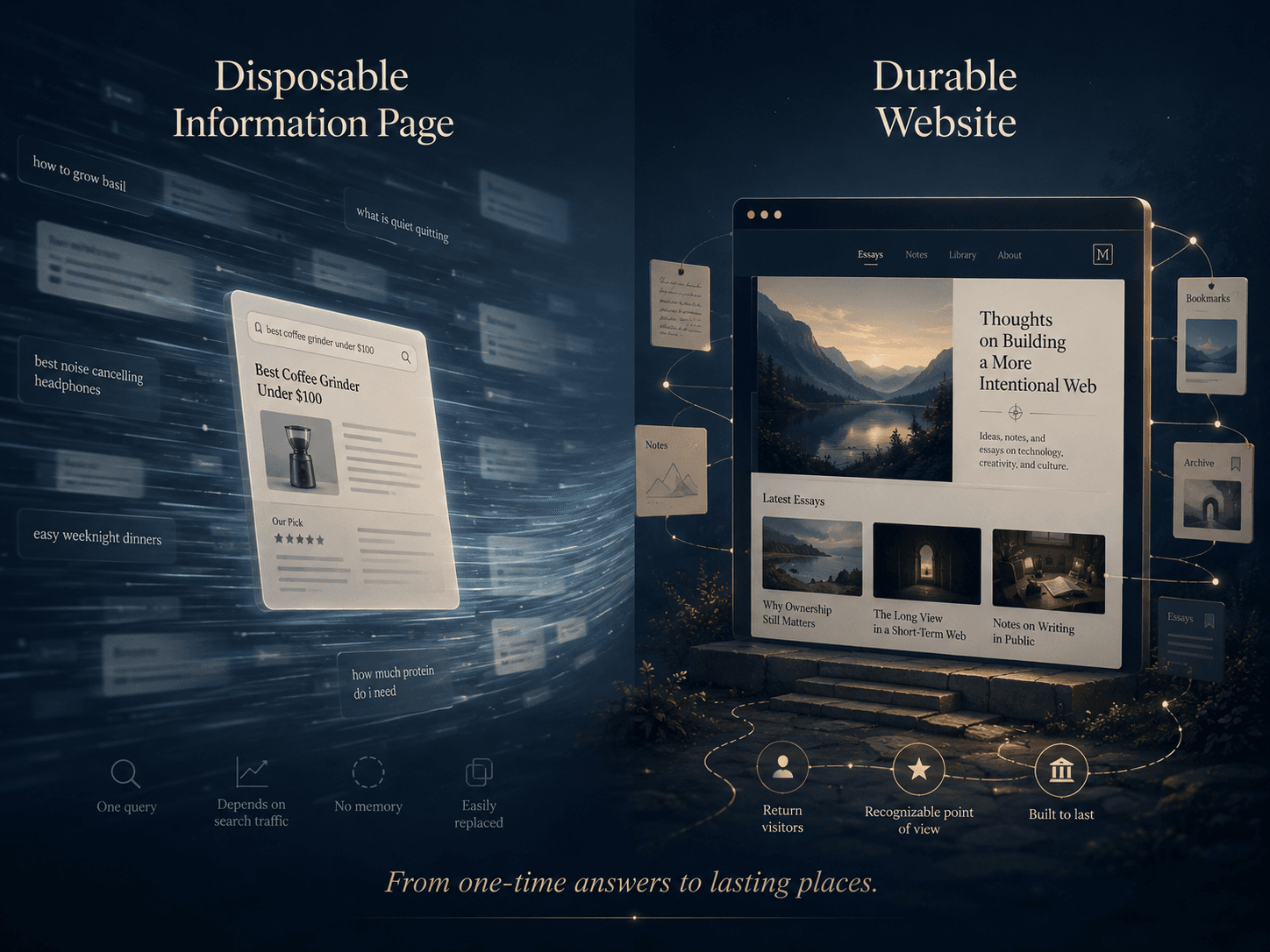
The Commercial Layer
There is also a commercial layer, but it should be treated carefully.
Independent websites can support advertising, affiliate links, digital products, consulting, services, sponsorships, memberships, newsletters, communities, events, software, or physical products. A site can be part of a business model. It can help a small team or independent creator build a more stable relationship with an audience.
But monetization works better when it follows usefulness.
A site that exists only to capture traffic and extract revenue is fragile. It may work for a while, especially if search or social distribution is favorable, but it has little defense when discovery patterns change. If visitors do not remember the source, trust the judgment, or return by choice, the commercial layer remains dependent on external routing.
A more durable site earns commercial possibilities because it has already created value.
This does not require a large audience. A small, specific, trusted audience can be more meaningful than a large, accidental one. For some projects, the commercial value may come from selling products. For others, it may come from reputation, consulting, recruitment, publishing, software adoption, or partnership opportunities.
The important point is not that every independent website should become a business. Many should not. Some exist for research, art, documentation, public service, or personal expression.
The point is that a website with trust, memory, and usefulness has more optionality than a page built only for traffic.
The Independent Website as a Durable Place
If the internet is becoming more answer-driven, independent websites need to become less like disposable information pages and more like durable places.
A disposable information page answers one query. It may be accurate. It may be useful. But once its answer is extracted, there is little reason to remember where it came from.
A durable website does something else.
It gives context. It preserves memory. It reflects a point of view. It helps people return. It gives a project a home that is not entirely dependent on the rhythms of a feed or the packaging of an answer interface.
This is not a guarantee of success. Independent websites still need distribution, maintenance, design, clarity, and patience. Many will remain small. Many will be ignored. Some will be useful only to a narrow group of people, which may be perfectly enough.
But the case for independent websites is not weaker because answers are everywhere.
It is simply different.
When information is abundant, the scarce thing is not another explanation. It is a source worth trusting. It is a place where ideas can accumulate without being immediately flattened into the next feed item or summary. It is a structure that lets people see not only what is known, but how someone thinks.
The independent website still matters because the web still needs places.
Not every answer needs a destination. But understanding often does.